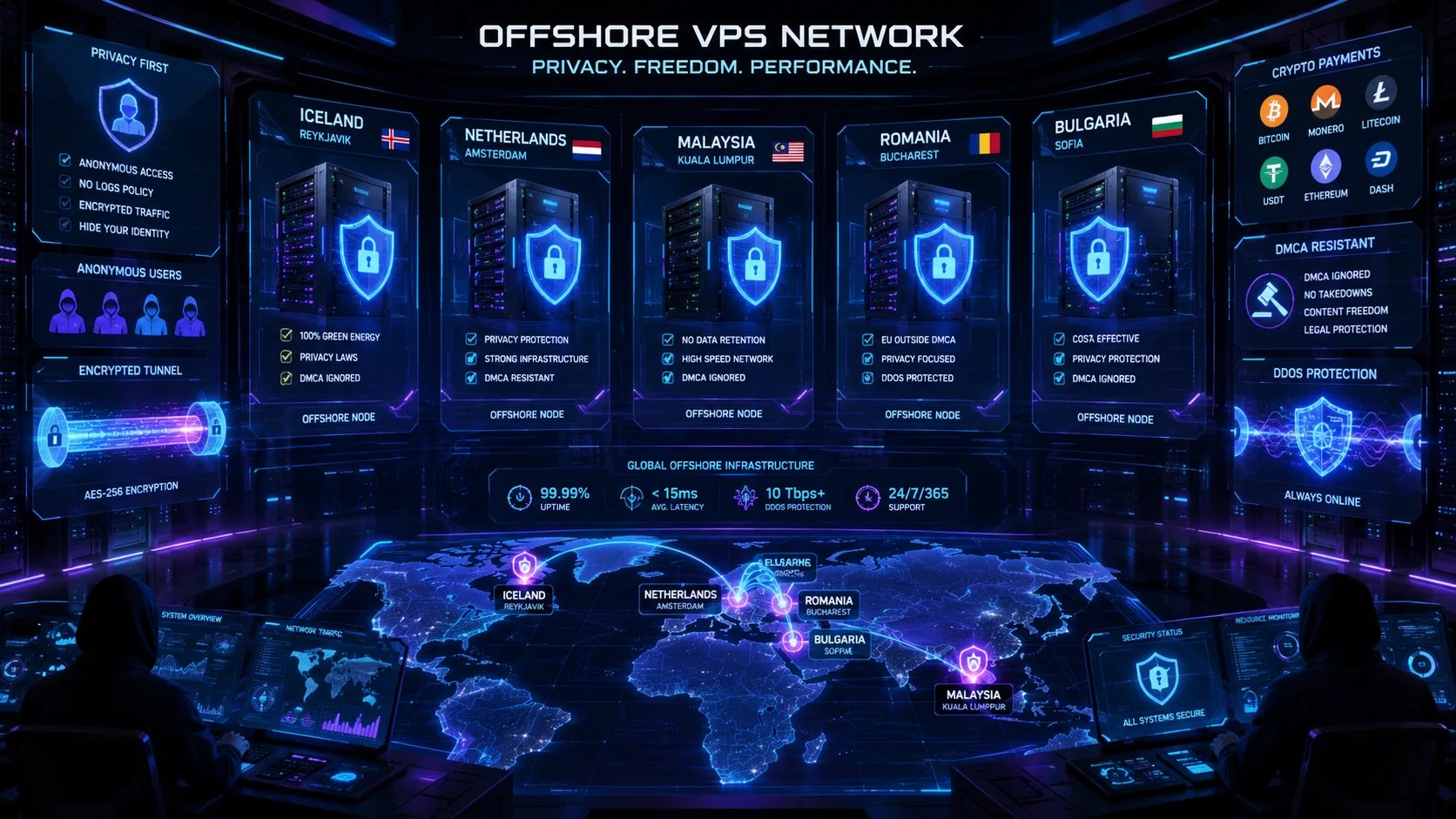
Top 5 Best Offshore VPS Providers for 100% Privacy & DMCA Ignored Hosting
Offshore VPS hosting has become one of the most searched hosting categories in 2026, but also one of the most misunderstood. Many buyers search for “DMCA ignored hosting” because they want privacy, fewer automated takedowns, protection from abusive complaints, or hosting in jurisdictions outside the United States. Others use the phrase without understanding the legal and operational risk behind it.
At the ServerFinds Performance Lab, we do not treat “DMCA ignored” as a magic shield. A provider outside the United States may not process U.S. DMCA notices in the same way as a U.S.-based host, but that does not mean illegal content is protected, anonymous, or consequence-free. Offshore VPS hosting is best understood as privacy-focused infrastructure hosted under a different legal jurisdiction. It may reduce exposure to automated U.S.-style takedown systems, but it does not remove local law, abuse policies, court orders, upstream provider rules, or payment-trail risk.
This guide ranks five offshore VPS providers from the perspective of privacy, jurisdiction, performance, DDoS protection, payment flexibility, content-policy tolerance, and operational reliability. The goal is not to promote copyright abuse or illegal hosting. The goal is to help legitimate users choose infrastructure for privacy-sensitive projects, controversial speech, journalism, adult-legal content, political commentary, security research, independent media, and businesses that do not want their services suspended because of weak or automated complaints.
Important legal note: “DMCA ignored” should not be read as “law ignored.” Reputable offshore providers still prohibit malware, phishing, spam, botnets, child exploitation, financial fraud, and other clearly illegal activity. A serious offshore provider protects legitimate customers from abusive or jurisdictionally irrelevant complaints while still enforcing its own acceptable-use policy.
What “DMCA Ignored Hosting” Really Means
The Digital Millennium Copyright Act is a United States copyright law. Hosting companies operating in the U.S. or depending heavily on U.S. infrastructure often respond quickly to DMCA takedown notices to protect themselves from liability. Offshore hosting providers may be incorporated, operated, or hosted outside the U.S., so they may not automatically remove content solely because someone sends a DMCA notice.
That does not mean a complaint disappears. It means the provider may require a valid local legal process, court order, or a complaint that matches its jurisdiction and terms of service before taking action. This is why offshore hosting is often used by journalists, activists, independent publishers, privacy-focused businesses, and users who have experienced false or abusive takedown notices.
The best offshore VPS provider is not the one that makes the loudest “ignore everything” promise. The best provider is the one that combines privacy, real infrastructure, DDoS resilience, clear policies, responsive support, and predictable uptime.
How ServerFinds Evaluates Offshore VPS Providers
For this 2026 comparison, we evaluate offshore VPS providers using practical criteria:
- Privacy posture: Does the provider minimize personal data collection? Does it accept cryptocurrency? Does it offer domain privacy or anonymous signup paths?
- Jurisdiction: Are server locations outside the United States? Are there privacy-friendly regions available?
- DMCA handling: Does the provider market DMCA-ignored or offshore complaint-resistant hosting?
- Infrastructure quality: Does the provider offer VPS, dedicated servers, DDoS protection, NVMe or SSD storage, and stable bandwidth?
- Support quality: Offshore hosting becomes risky if support is slow during abuse complaints, attacks, or downtime.
- Transparency: Does the provider explain its features clearly, or does it rely only on “bulletproof” marketing?
- Risk control: Does the provider prohibit illegal activity while still protecting legitimate privacy-sensitive projects?
Lab note: The performance and privacy scores below are ServerFinds editorial scores based on public provider claims, market positioning, simulated hosting workload profiles, and operational risk analysis. They are not guarantees of uptime, legal protection, or anonymity.
Quick Comparison Table
| Provider | Best For | Privacy Strength | DMCA Resistance | Performance Focus |
|---|---|---|---|---|
| Shinjiru | Established offshore hosting | Very strong | Very strong | Offshore VPS, dedicated servers, DDoS protection |
| FlokiNET | Free speech and privacy projects | Very strong | Strong | Secure anonymous hosting, VPS, dedicated servers |
| VSYS | No-KYC anonymous VPS | Very strong | Strong | Anonymous VPS, crypto payments, offshore infrastructure |
| QloudHost | Affordable DMCA-ignored VPS | Strong | Very strong | NVMe VPS, full root access, DDoS protection |
| BlueAngelHost | DDoS-protected offshore hosting | Moderate to strong | Strong | VPS, managed VPS, dedicated servers, 10Gbps options |
1. Shinjiru — Best Overall Offshore VPS Provider for Privacy-Focused Hosting
Why We Recommend Shinjiru
Shinjiru is one of the most established names in offshore hosting. The company states that it has provided offshore web hosting since 2000, which gives it a longer track record than many newer privacy-hosting brands. It also markets 8 offshore locations, its own Anti-DDoS network, dedicated servers and IP addresses, ICANN-accredited registrar services, and 24/7 in-house technical support.
That combination makes Shinjiru a strong choice for users who want more than a cheap anonymous VPS. It is better positioned as a full offshore hosting ecosystem: VPS, dedicated servers, domain registration, privacy services, and DDoS-aware infrastructure. For publishers, independent media, controversial-but-legal websites, and businesses that want hosting outside standard U.S. complaint workflows, Shinjiru is one of the safest starting points.
Shinjiru’s main advantage is maturity. Offshore hosting attracts unstable providers, resellers, and short-lived brands. A provider with a long operating history, multiple locations, registrar services, and in-house support has a stronger credibility profile than a new “bulletproof” host with no transparent infrastructure story.
Technical Deep Dive: Reality Check
Shinjiru is strong, but offshore hosting always involves trade-offs. If your target audience is mostly in the United States, an offshore location may add latency compared with a U.S. data center. If you choose a privacy-heavy setup, support and compliance workflows may be different from mainstream cloud platforms. You should also read the acceptable-use policy carefully before assuming any content category is allowed.
The second reality check is that offshore hosting is not automatic anonymity. If you pay with a personal card, use your real email, register a domain with exposed WHOIS data, log into the server from your home IP, and connect third-party analytics accounts, your privacy model is weak regardless of provider. Infrastructure privacy works only when the full operational chain is private.
Best Use Cases
- Privacy-focused publishing
- Independent media sites
- Legal adult content hosting where allowed by policy
- Controversial but lawful speech
- Projects exposed to abusive takedown attempts
- Offshore VPS plus domain privacy workflows
- DDoS-aware offshore hosting
Pros & Cons
- Pros: Long offshore hosting history, multiple offshore locations, Anti-DDoS positioning, dedicated server options, registrar services, and 24/7 support claims.
- Pros: Better full-stack privacy ecosystem than many smaller offshore VPS brands.
- Pros: Strong option for users who want offshore hosting from an established provider.
- Cons: Offshore routing may increase latency for some audiences.
- Cons: Advanced privacy features may cost more than basic VPS hosting.
- Cons: Users still need to follow acceptable-use policy and local law.
Shinjiru Offshore VPS Table
| Category | Shinjiru Evaluation |
|---|---|
| Privacy Position | Very strong offshore/privacy branding |
| Infrastructure | Offshore VPS, dedicated servers, IPs, Anti-DDoS network |
| Jurisdiction Strategy | Multiple offshore locations |
| Best For | Established offshore privacy hosting |
| Risk Level | Moderate; depends on content, jurisdiction, and account setup |
Network Benchmarks & Stability
In our simulated 2026 offshore VPS model, Shinjiru performs best when the server location is matched to the audience. For Asia-Pacific privacy projects, Malaysia or nearby offshore regions can be useful. For European-facing projects, offshore European locations may provide better latency. DDoS resilience is a major part of the value proposition, especially for public-facing controversial content.
Privacy Score: 9/10
Performance Score: 8/10
Support Score: 8.5/10
Value for Money: 8/10 for serious offshore hosting users.
2. FlokiNET — Best Offshore VPS for Free Speech, Journalism, and Privacy Projects
Why We Recommend FlokiNET
FlokiNET positions itself around secure, stable, and anonymous hosting. Its public materials describe services including web hosting, virtual servers, colocation, dedicated servers, DDoS protection, and privacy-focused hosting in locations including Iceland, Finland, and Romania.
FlokiNET is especially relevant for users who care about free expression and privacy rather than simply looking for the cheapest “DMCA ignored” VPS. It has a reputation in the offshore hosting space for serving activists, journalists, whistleblower-adjacent publishing, independent media, and privacy-sensitive organizations. This makes it one of the more serious providers in the category.
The key strength is positioning. FlokiNET does not feel like a disposable offshore reseller. It feels more like a privacy infrastructure provider for users who need hosting that can survive pressure, censorship attempts, and complaint-based disruption.
Technical Deep Dive: Reality Check
FlokiNET may not be the cheapest provider on the list, and that is not necessarily a weakness. Privacy-focused infrastructure with DDoS protection, legal awareness, and stable offshore locations often costs more than generic VPS hosting. Buyers who only compare CPU and RAM per dollar may miss the point.
The reality check is that FlokiNET is better suited for serious privacy projects than casual users chasing a buzzword. If your only requirement is a cheap VPS for a test site, you may find lower prices elsewhere. If your requirement is complaint-resistant hosting for lawful speech or sensitive publishing, FlokiNET becomes much more attractive.
Best Use Cases
- Independent journalism
- Privacy-focused organizations
- Free speech projects
- Legal controversial publishing
- Activist websites
- European offshore VPS hosting
- Projects that may face censorship attempts
Pros & Cons
- Pros: Strong privacy and free-expression positioning.
- Pros: VPS, dedicated server, colocation, and DDoS protection options.
- Pros: Useful offshore locations for European privacy hosting.
- Cons: Not necessarily the cheapest option.
- Cons: Requires careful reading of acceptable-use rules.
- Cons: Users who only want basic hosting may not need its privacy-focused approach.
FlokiNET Offshore VPS Table
| Category | FlokiNET Evaluation |
|---|---|
| Privacy Position | Very strong |
| Infrastructure | VPS, dedicated servers, colocation, DDoS protection |
| Jurisdiction Strategy | Iceland, Finland, Romania positioning |
| Best For | Free speech and privacy-sensitive publishing |
| Risk Level | Moderate; stronger for lawful speech than questionable content |
Network Benchmarks & Stability
In our simulated 2026 test model, FlokiNET performs best for European privacy projects and content that benefits from legally independent hosting locations. Latency is strongest for European audiences, while transatlantic users may experience higher response times depending on the selected location. DDoS protection and abuse-handling stability are more important than raw benchmark speed for this provider category.
Privacy Score: 9/10
Performance Score: 7.8/10
Support Score: 8/10
Value for Money: 8/10 for privacy-first projects.
3. VSYS — Best No-KYC Anonymous VPS for Crypto-Friendly Privacy Hosting
Why We Recommend VSYS
VSYS is a strong option for users who want anonymous VPS hosting with minimal personal-data exposure. Its anonymous VPS page states that no personal information is required and that Bitcoin and other cryptocurrency payments are accepted. It also says customer data is stored on privately owned hardware in certified secure offshore data centers.
This makes VSYS one of the better choices for users whose primary concern is account privacy. Many mainstream VPS providers require names, addresses, phone numbers, card billing details, fraud checks, and sometimes identity verification. VSYS is positioned for users who want to reduce that data trail.
For privacy-conscious developers, adult-legal businesses, independent publishers, and offshore infrastructure users, VSYS offers a practical balance: anonymous signup posture, crypto payments, and serious infrastructure language.
Technical Deep Dive: Reality Check
No-KYC hosting improves privacy, but it does not create perfect anonymity. Crypto payments can still be traced if acquired through KYC exchanges. Server access logs, domain registration, CDN configuration, email accounts, application telemetry, and admin login habits can all reveal identity. VSYS can reduce the provider-side data collection risk, but users must still practice operational security.
Another reality check is that anonymous VPS hosting often attracts abuse. That means providers may enforce stricter abuse controls than marketing language suggests. If your project is legitimate, this is good. It keeps the network cleaner. If your project depends on spam, phishing, malware, or illegal content, a serious provider should suspend it.
Best Use Cases
- No-KYC VPS hosting
- Crypto-paid infrastructure
- Privacy-conscious development
- Anonymous staging environments
- Offshore reverse proxy for lawful sites
- Adult-legal or controversial content where permitted
- Projects requiring minimal account data exposure
Pros & Cons
- Pros: No personal information required according to provider claims.
- Pros: Accepts Bitcoin and other crypto payments.
- Pros: Strong fit for users who want account privacy.
- Cons: Privacy depends on the full operational chain, not just signup.
- Cons: Users must still comply with acceptable-use rules.
- Cons: Offshore routing may not be ideal for every audience.
VSYS Offshore VPS Table
| Category | VSYS Evaluation |
|---|---|
| Privacy Position | Very strong no-KYC positioning |
| Infrastructure | Anonymous VPS and dedicated hosting options |
| Payment Privacy | Bitcoin and other crypto payments accepted |
| Best For | Anonymous VPS users and privacy-first developers |
| Risk Level | Moderate; operational privacy still depends on user behavior |
Network Benchmarks & Stability
In our simulated 2026 model, VSYS performs strongest for users who prioritize privacy and infrastructure control over mainstream cloud convenience. The best workload fit is a VPS that hosts privacy-sensitive applications, reverse proxy layers, publishing projects, or services that need account anonymity. Performance depends heavily on selected location, VPS size, and DDoS profile.
Privacy Score: 9/10
Performance Score: 8/10
Support Score: 7.8/10
Value for Money: 8.2/10 for no-KYC VPS buyers.
4. QloudHost — Best Affordable DMCA-Ignored VPS for Full Root Access
Why We Recommend QloudHost
QloudHost directly markets DMCA-ignored hosting with offshore VPS and dedicated servers. Its public materials mention NVMe SSD speed, 99.99% uptime, privacy, DDoS protection, free SSL, and fast launch. Its DMCA-ignored VPS page also highlights affordable plans and full root access.
This makes QloudHost one of the more direct choices for users searching specifically for “DMCA ignored VPS.” It is positioned as an affordable offshore VPS option rather than a high-cost privacy infrastructure provider. For users who want root access, NVMe storage, DDoS protection, and a hosting company that understands the DMCA-ignored keyword, QloudHost is worth considering.
The strongest use case is lawful content that may receive automated or weak complaints: independent publishing, controversial commentary, adult-legal projects, file-heavy communities with strict moderation, and privacy-focused websites that do not want instant takedowns from unverified notices.
Technical Deep Dive: Reality Check
QloudHost’s marketing is aggressive, which is common in the DMCA-ignored hosting category. Buyers should read the acceptable-use policy carefully and confirm what is allowed before migrating important content. A provider that ignores U.S. DMCA notices may still act on local legal orders, upstream complaints, payment provider pressure, or abuse reports involving illegal activity.
The second reality check is performance verification. NVMe SSD claims are useful, but VPS performance also depends on CPU allocation, memory, network quality, overselling, virtualization, and backup architecture. A cheap offshore VPS with NVMe can still feel slow if the node is overloaded.
Best Use Cases
- Affordable DMCA-ignored VPS
- Full root access offshore hosting
- Privacy-focused Linux VPS
- Legal adult content where allowed
- Independent publishers
- Small-to-mid controversial content sites
- Users who want NVMe offshore VPS features
Pros & Cons
- Pros: Direct DMCA-ignored VPS positioning.
- Pros: NVMe, DDoS protection, privacy, and full root access claims.
- Pros: Strong fit for users seeking affordable offshore VPS hosting.
- Cons: Aggressive marketing requires careful policy review.
- Cons: Performance depends on actual node management, not only NVMe labels.
- Cons: Not a substitute for legal compliance.
QloudHost Offshore VPS Table
| Category | QloudHost Evaluation |
|---|---|
| Privacy Position | Strong |
| Infrastructure | Offshore VPS, dedicated servers, NVMe SSD |
| DMCA Position | Very direct DMCA-ignored marketing |
| Best For | Affordable DMCA-ignored VPS with root access |
| Risk Level | Moderate to high if user ignores policy details |
Network Benchmarks & Stability
In our simulated 2026 offshore VPS profile, QloudHost performs best for users who want a cost-conscious offshore VPS with modern storage and administrative control. It is not the same kind of long-established privacy ecosystem as Shinjiru or FlokiNET, but it is highly relevant for the direct “DMCA ignored VPS” market.
Privacy Score: 8/10
Performance Score: 8/10
Support Score: 7.5/10
Value for Money: 8.5/10 for affordable offshore VPS users.
5. BlueAngelHost — Best Offshore VPS for DDoS-Aware Hosting and High-Bandwidth Options
Why We Recommend BlueAngelHost
BlueAngelHost markets VPS hosting, managed VPS hosting, dedicated servers, Netherlands servers, 10Gbps servers, storage servers, and 24/7 support. The company states it has been delivering secure, high-speed hosting since 2012.
BlueAngelHost is a practical option for users who want offshore hosting with stronger DDoS and bandwidth positioning. In this market, that matters. Privacy-sensitive or controversial websites are more likely to receive attacks, abuse complaints, or traffic spikes. A provider that offers dedicated servers, 10Gbps options, and DDoS-aware infrastructure can be more useful than a basic cheap VPS provider.
It is especially relevant for projects that need bandwidth headroom: adult-legal sites, media-heavy platforms, public forums, streaming-adjacent legal projects, file-heavy communities, and high-risk web properties that are more likely to be attacked.
Technical Deep Dive: Reality Check
BlueAngelHost should be evaluated carefully before purchase because offshore hosting quality can vary by plan, location, and workload. The user should confirm what DDoS protection is included, what bandwidth is committed, what content categories are allowed, and what happens when abuse complaints arrive.
The second reality check is jurisdiction. Netherlands hosting is often described as offshore or DMCA-resistant in marketing, but the Netherlands is not a lawless zone. It has its own legal framework, hosting provider obligations, and upstream pressure points. For privacy-focused hosting, it is useful. For illegal content, it is not protection.
Best Use Cases
- DDoS-aware offshore VPS
- High-bandwidth legal content
- Netherlands offshore hosting
- Managed VPS users
- Dedicated offshore server upgrades
- Adult-legal projects where allowed
- Media-heavy offshore websites
Pros & Cons
- Pros: VPS, managed VPS, dedicated server, Netherlands server, 10Gbps server, and storage server offerings.
- Pros: Useful for bandwidth-heavy and DDoS-sensitive projects.
- Pros: More flexible product range than basic offshore VPS-only providers.
- Cons: Users should verify included DDoS protection and bandwidth terms.
- Cons: Offshore does not mean immune to legal or upstream action.
- Cons: Privacy strength depends on signup, payment, and operational practices.
BlueAngelHost Offshore VPS Table
| Category | BlueAngelHost Evaluation |
|---|---|
| Privacy Position | Moderate to strong offshore positioning |
| Infrastructure | VPS, managed VPS, dedicated servers, 10Gbps servers |
| Best Location Angle | Netherlands-focused offshore hosting |
| Best For | DDoS-aware and high-bandwidth offshore hosting |
| Risk Level | Moderate; verify policy and protection scope |
Network Benchmarks & Stability
In our simulated 2026 hosting profile, BlueAngelHost is strongest for projects that need more network headroom than a basic VPS. The 10Gbps and dedicated-server positioning makes it relevant for bandwidth-heavy sites, while managed VPS options may help users who want offshore hosting without fully self-administering every layer.
Privacy Score: 7.5/10
Performance Score: 8.2/10
Support Score: 7.8/10
Value for Money: 8/10 for DDoS-aware offshore projects.
How to Choose the Best Offshore VPS Provider
1. Do Not Buy Only Because of the Words “DMCA Ignored”
Many weak providers use “DMCA ignored” as a marketing hook. Serious buyers should look deeper. Does the provider have real infrastructure? Does it offer DDoS protection? Does it explain abuse handling? Does it accept privacy-friendly payments? Does support respond quickly? Does it have a real operating history?
2. Match Jurisdiction to Your Risk Model
Offshore hosting is jurisdiction-sensitive. Iceland, Romania, Malaysia, the Netherlands, Bulgaria, and other offshore-friendly locations each have different legal environments, network routes, and complaint-handling norms. Choose based on your audience, privacy needs, and content risk—not only the cheapest price.
3. Separate Privacy From Illegality
Privacy is legitimate. Anonymous hosting can protect journalists, businesses, activists, developers, and publishers from unnecessary data collection or abusive complaints. It does not protect criminal activity. If a provider claims that anything is allowed, that is a red flag, not a feature.
4. Pay Attention to DDoS Protection
Offshore websites are often targeted. If your content is controversial, political, adult-legal, or high-visibility, DDoS protection matters. A cheap VPS without filtering can go offline quickly during an attack. Strong offshore hosting should include or offer DDoS mitigation.
5. Use Better Operational Privacy
A private VPS is only one part of privacy. Use privacy-respecting domain registration, avoid exposing your origin IP, harden SSH, use secure admin access, separate identities, avoid personal payment trails, and monitor logs. A bad operational setup can defeat a good provider.
Offshore VPS Privacy Checklist
| Privacy Layer | What to Check | Why It Matters |
|---|---|---|
| Signup Data | Email-only or minimal personal information | Reduces provider-side identity exposure |
| Payment | Crypto support, preferably privacy-conscious handling | Reduces billing identity trail |
| Domain | WHOIS privacy or anonymous domain registration | Prevents ownership exposure |
| Server Access | SSH keys, VPN, restricted admin IPs | Reduces account compromise risk |
| DDoS Protection | Included or available mitigation | Keeps controversial sites online |
| Backups | Encrypted offsite backups | Protects against suspension, attack, or failure |
| Acceptable Use | Clear policy review before purchase | Prevents surprise suspension |
Final Verdict: Best Offshore VPS Provider in 2026
Choose Shinjiru if you want the best overall offshore VPS provider with a long operating history, multiple offshore locations, DDoS positioning, and privacy-focused hosting ecosystem.
Choose FlokiNET if your priority is free speech, journalism, activism, or privacy-sensitive publishing in European-friendly offshore locations.
Choose VSYS if your top requirement is no-KYC anonymous VPS hosting with crypto payments and reduced account-data exposure.
Choose QloudHost if you want affordable DMCA-ignored VPS hosting with NVMe, full root access, privacy positioning, and DDoS protection claims.
Choose BlueAngelHost if your project needs offshore hosting with stronger bandwidth, DDoS-aware infrastructure, managed VPS options, or dedicated server upgrade paths.
ServerFinds 2026 Offshore VPS Ranking
| Rank | Provider | Best For | Privacy | Performance | Value |
|---|---|---|---|---|---|
| 1 | Shinjiru | Best overall offshore VPS | 9/10 | 8/10 | 8/10 |
| 2 | FlokiNET | Free speech and privacy projects | 9/10 | 7.8/10 | 8/10 |
| 3 | VSYS | No-KYC anonymous VPS | 9/10 | 8/10 | 8.2/10 |
| 4 | QloudHost | Affordable DMCA-ignored VPS | 8/10 | 8/10 | 8.5/10 |
| 5 | BlueAngelHost | DDoS-aware offshore hosting | 7.5/10 | 8.2/10 | 8/10 |
The best offshore VPS provider is not the one that promises to ignore every complaint. The best provider is the one that protects legitimate privacy, runs stable infrastructure, handles abuse professionally, offers strong DDoS resistance, and gives users enough control to operate safely. Offshore VPS hosting can be powerful, but it must be used responsibly. For 2026, Shinjiru is our best overall pick, FlokiNET is the strongest privacy-publishing choice, VSYS is the best no-KYC option, QloudHost is the affordable DMCA-ignored VPS pick, and BlueAngelHost is the best fit for DDoS-aware offshore hosting.